Euphorbia aeruginosa (WA Prohibited)
Euphorbia aeruginosa is a small, spiny succulent species native to the Northern Cape Province of South Africa, where it grows among rocky quartzite outcrops in arid, sun-exposed habitats. It forms sprawling, multi-branched clumps of thin, upright to decumbent stems that are distinctly blue-green in colour, often with a powdery bloom. The stems are lined with prominent ridges bearing sharp, reddish paired spines, and under bright conditions, the plant may take on a purplish hue. Small yellow cyathia are produced near the stem tips during the growing season, typically in spring and summer.
Care Tips:
- Light – Requires full sun or bright filtered light; strong light enhances colour and compactness
- Water – Water deeply but infrequently; always allow soil to dry thoroughly between waterings
- Humidity – Best in dry conditions; avoid overly humid environments
- Media – Use a well-draining mix with added sand, grit, or pumice
- Temperature – Maintain above 10°C; protect from frost and prolonged cold
- Fertiliser – Feed with a diluted cactus fertiliser during the active growing season
- Repotting – Repot only when rootbound or when soil has degraded
Additional Notes:
- Known to be toxic
Original: $8.57
-65%$8.57
$3.00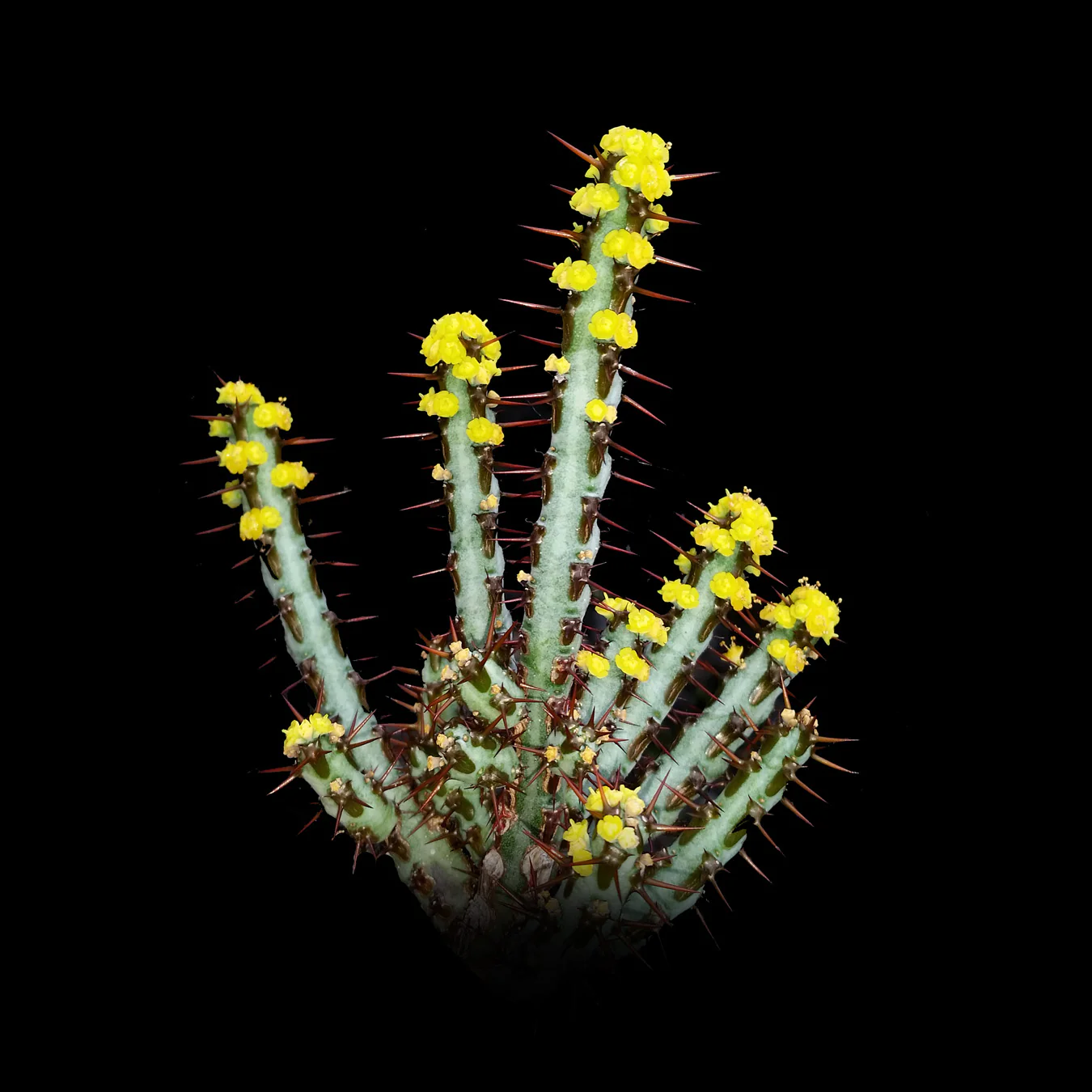


Description
Euphorbia aeruginosa is a small, spiny succulent species native to the Northern Cape Province of South Africa, where it grows among rocky quartzite outcrops in arid, sun-exposed habitats. It forms sprawling, multi-branched clumps of thin, upright to decumbent stems that are distinctly blue-green in colour, often with a powdery bloom. The stems are lined with prominent ridges bearing sharp, reddish paired spines, and under bright conditions, the plant may take on a purplish hue. Small yellow cyathia are produced near the stem tips during the growing season, typically in spring and summer.
Care Tips:
- Light – Requires full sun or bright filtered light; strong light enhances colour and compactness
- Water – Water deeply but infrequently; always allow soil to dry thoroughly between waterings
- Humidity – Best in dry conditions; avoid overly humid environments
- Media – Use a well-draining mix with added sand, grit, or pumice
- Temperature – Maintain above 10°C; protect from frost and prolonged cold
- Fertiliser – Feed with a diluted cactus fertiliser during the active growing season
- Repotting – Repot only when rootbound or when soil has degraded
Additional Notes:
- Known to be toxic